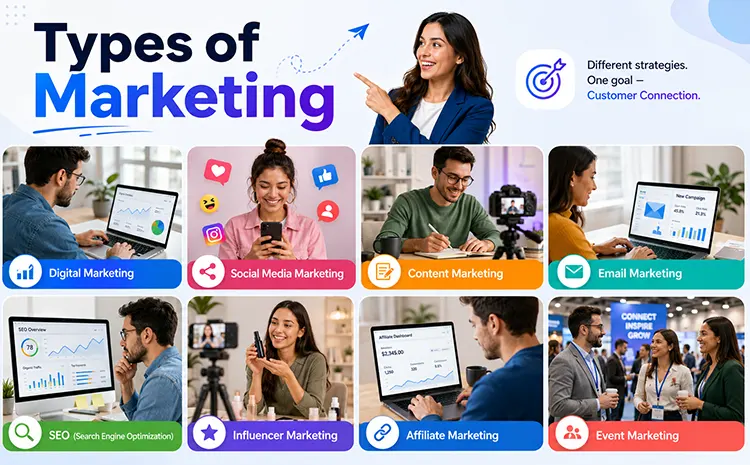
Do you know the different types of marketing and how they can help your sales strategy? We’ll show you the different types of marketing. Still don’t know what marketing is? We’ll tell you about the different types of marketing and how they can help your sales strategy…
Marketing is about generating interest in your company’s product or service. To achieve this goal, you need to conduct market research and analyse the interests of potential customers beforehand. Marketing methods are strategies that companies use to support business growth.
However, marketing has adapted to changes, and traditional techniques, although still used, have become less prominent, leading to new types of marketing and new approaches to attract customers that better meet the needs of both businesses and customers.
Types of Offline or Traditional Marketing
It is the form of marketing that was widely used before the arrival of digital media.
Its objective is to publicise the products and services and to increase their sales.
To achieve this, it uses radio, television, the press, and billboards, as well as other printed media and participation in fairs and events.
Typically, these types of strategies have a higher cost because they require more detailed planning of the actions to be carried out and also require more resources to implement.
Despite these drawbacks, they are a suitable option because they make it easier for your ads to reach a large audience; they are well-established and far-reaching media.
On the other hand, some users still do not use the Internet, so if you do not launch offline strategies, you will miss out on those potential customers.
Furthermore, it can be very relevant for local businesses, as it is very effective, although its cost can be somewhat high. For example, outdoor advertising on bus shelters or public transport and leaflet distribution can be effective. These are media that can increase brand exposure; although they are more expensive, you ensure a certain impact.
However, the best option is to combine offline and online marketing, so your message will get better results.
Types of Digital Marketing
| Type of Marketing | Main Approach | Common Channels |
| Traditional Marketing | Reaches audiences through offline channels | Television, radio, newspapers, billboards, events |
| Outbound Marketing | Proactively reaches potential customers | Paid advertising, direct marketing, email |
| Inbound Marketing | Attracts audiences through relevant content and experiences | Websites, blogs, social media |
| Content Marketing | Uses valuable content to attract and engage audiences | Blogs, videos, guides, social media |
| Email Marketing | Communicates with subscribers and customers | Newsletters, promotional emails, transactional emails |
| Social Media Marketing | Promotes and engages through social platforms | Facebook, X, LinkedIn, Instagram, YouTube, TikTok |
| SEO | Improves visibility in organic search results | On-page SEO, technical SEO, link building |
| SEM | Uses paid search advertising to gain visibility | Search ads, PPC campaigns |
| Neuromarketing | Applies neuroscience-related methods to marketing research | Eye tracking, physiological and neural measures |
Online marketing, or digital marketing, emerged with the arrival of the internet, enabling businesses to attract their target audience, promote their products, and make sales.
Digital marketing encompasses a set of strategies whose purpose is the promotion of the brand, company or business through the internet.
Unlike traditional marketing, digital marketing uses digital channels and methodologies that allow for real-time analysis of results.
Within this type, we can find various options; the most relevant ones will be detailed below.
Outbound and Inbound Marketing
Outbound marketing is the set of marketing actions whose objective is to obtain leads (potential customers) through direct and unidirectional methods.
Inbound marketing, on the other hand, combines non-intrusive marketing and advertising to attract consumers by providing them with valuable content and relevant experiences.
Outbound marketing focuses on the brand and the product, highlighting its features and benefits. It establishes a direct connection with the customer because it lacks sufficient data and reaches them before they have requested that information, which can make it seem intrusive.
In this type of marketing there is no feedback from the consumer since communication is one-way.
It has a large audience reach, but this is risky because you invest money in customers who may not be interested in your product or service.
It usually requires a large investment since it involves purchasing paid advertising space.
Its results are difficult to measure due to the channels it uses.
Inbound marketing, on the other hand, focuses on the potential customer, seeking to gain their interest and trust with relevant content. Therefore, it attracts the customer, rather than interrupting them.
The media it uses are digital, such as websites, blogs, social networks, etc., which allows for interactive communication and makes it easier to understand the needs and opinions of potential customers.
By focusing your efforts on the tastes and needs of the buyer persona, it is possible to reach a more qualified audience, that is, one more interested in our product or service.
It may require a different budget than outbound marketing because it involves creating content that aims to inform and entertain, rather than sell directly.
Because it uses digital media, its results are easily measurable thanks to digital tools, which makes it possible to check the performance of the actions taken, as well as modify the strategy if the objectives are not met.
Also Check: Advantages And Disadvantages Of Inbound & Outbound Marketing
Content Marketing
Content marketing is a strategy based on creating and distributing valuable content to attract the target audience and convert them from potential customers to actual customers, at the right time and through the right channel, with a specific objective.
Content marketing is important because it offers many benefits:
Improve your branding and awareness: you can demonstrate that your product or service is the solution to your target audience’s needs. It allows you to gain authority because, by developing your content, you become a leader in your industry. This will position you as a top-of-mind choice for consumers, increasing the likelihood that they will choose you.
It has a significant advantage: it is present throughout the entire purchase process, from attraction to loyalty; that is, it accompanies you throughout the customer journey and provides valuable content according to the stage the customer is at in the purchase process.
It increases traffic, because if you manage to spread valuable content through the right channels, you will attract visits to the website.
Generate engagement by creating valuable content that favours your buyer persona and builds trust with them. Attract leads; with content, you can capture the attention of potential customers and build loyalty.
Email Marketing
Email marketing consists of sending emails to a database of contacts who have previously authorised their receipt, with the aim of acquiring new customers, maintaining relationships with current customers, interacting with them, increasing loyalty and customer retention, boosting sales, confirming a purchase, etc.
Emails are a fundamental element for business growth, as businesses can use them in various ways, from order confirmation to newsletters.
It allows for closer and more personal communication with customers, as well as providing them with added value. Email campaigns can be measured using conversion rates and other performance metrics.
It’s a way to support upselling. Even if the recipient is already a customer, they may not know all the products or services you offer, so this approach is a useful way to introduce them. It keeps your brand visible to consumers, so when they have a need, your company is one of the options they consider.
It facilitates personalisation through dynamic content and the ability to speak directly with your customers, making them feel valued. If the content is more personalised, the chances of conversion will be greater.
Email marketing can be used to promote a product or service. For example, sending mass emails at a specific time of year allows you to communicate news or promotions to a large part of your target audience quickly.
Most platforms used for this purpose allow you to evaluate the results of your campaigns.
This way, you can find out if you met your objectives and the profile of your target audience and then segment and focus on them in the next campaign.
They allow you to track metrics such as the open rate of the emails you have sent, bounce rate, location of the recipients, and click rate on the links you have included, which gives you very valuable information.
A relevant database allows you to segment and personalise emails based on interests, purchase stage, age, etc.
Personalising emails is essential because it makes the recipient feel special and allows you to build a relationship of trust with them.
To attract subscribers, you must comply with current regulations (GDPR), avoid buying or renting databases, and avoid sending emails to users who have not previously given their consent.
Social Media Marketing
Social media marketing, or marketing on social networks, is one of the types of marketing that encompasses the set of actions that a company carries out to promote its products or services and thus create a link with its target audience through social networks and blogs.
To implement a social media marketing strategy, you must follow these steps:
Situation analysis: knowing the current state of the company, the competition or the target audience can guide you to know which social networks to use.
Defining your social media plan will include the following aspects:
- Define the objectives: you need to know what you want to achieve with the campaign – branding, increasing web traffic, selling more with your e-commerce… Depending on the goal, you can set more than one objective.
- Defining the target audience: It’s essential to be clear about who we’re going to address and what audience we want to reach, because if we don’t segment, we can waste time and money. It’s necessary to know demographic variables such as age, gender, occupation, socioeconomic level, profession, etc.
- Choosing social media platforms: You’ll need to select the social media platforms that best suit your product or service. It’s recommended that you be present on several platforms to gain greater visibility and engagement.
- Facebook: You can share articles from your blog on your page, as well as in Facebook groups.
- X: It offers advertising options and allows you to improve your branding, as well as your online visibility. The character limit keeps the information from becoming overwhelming, and you can quickly determine if it’s relevant. Furthermore, using hashtags with keywords allows you to target specific market niches.
- LinkedIn: It’s used to connect with professionals in any sector, focusing on building relationships and connections. It’s most commonly used in B2B companies.
- Instagram: It can support branding, brand image, and engagement. It offers the opportunity to run influencer marketing campaigns, showcasing the benefits of your product or service in their photos or stories, which builds trust among your potential customers, especially when influencer marketing is relevant to your target audience.
- Google Business Profile: This free tool allows businesses to manage how they appear on Google Search and Google Maps. With a Google My Business listing, customers can learn about your products or services, contact you, and find you more easily.
- YouTube: provides a visual format for sharing video content, because Google also indexes videos in its search results.
- TikTok: It consists of short video clips to which music, effects, filters, or emojis can be added. The most popular are those featuring lip-syncing or choreography, as well as challenges and humorous videos.
- Choosing KPIs: It is necessary to define KPIs well in order to measure the effectiveness of the actions we carry out; growth of followers, clicks on links…
- Measuring results: It’s essential to track the results achieved to determine whether we are meeting the established objectives. Many tools allow us to measure these results; some are provided by the social media platforms themselves, while others are external applications.
SEO and SEM
SEO (Search Engine Optimisation) refers to the set of techniques used on a website to improve its position in the organic results of search engines; that is, it is the natural ranking of a page in search engines.
The goal of these strategies is to increase the visibility of a website.
SEM (Search Engine Marketing), on the other hand, refers to the practices carried out on a website to gain more visibility through paid advertising campaigns on search engines.
In this case, the advertiser bids to appear in the top search positions and must pay each time a user clicks on the ad.
The more clicks an advertiser receives, the higher the cost under a CPC model. This is called PPC (pay per click). The amount charged per click is called CPC (cost per click).
However, in SEO, there is no cost per visit, but it is very difficult to optimise a website to rank naturally in search results; this process requires a lot of work and time from professionals.
There are two critical optimisation factors that affect a website’s ranking:
- Relevance: Search engines assess relevance based on how well a page matches a user’s query and intent. To improve relevance, on-site SEO techniques are used: keyword and URL optimisation, improved user experience, faster loading times, etc.
- Authority: This aspect is related to how a website is recognised and trusted, and links from other websites can contribute to this. To improve it, off-site SEO techniques are used, such as link building.
To determine which strategy is best, you need to know how much time you have. In the short term, an SEM is immediate but long-term. An SEM campaign can provide visibility in paid search results.
With an SEO campaign, the results won’t be immediate but rather medium- to long-term. It takes more time because Google needs to recognise your site and start ranking it.
However, this does not imply that the SEM strategy, as one of the types of marketing, is better, since when you stop paying for a search advertising campaign, the paid placements generally stop.
Although SEO and SEM are different online marketing strategies, ideally they should be used together, as their combination will make it easier to optimise the results of your campaigns.
Neuromarketing
Neuromarketing consists of applying neuroscience techniques to marketing.
It seeks to understand the levels of attention people exhibit in response to different stimuli. This makes it possible to understand people’s behaviour toward brands and purchasing processes based on their neural activity.
Neuromarketing can be used, for example, to evaluate a product before its launch and to inform pricing strategies.
This can involve research methods such as eye tracking and other measures of physiological or neural responses.
There are techniques for implementing neuromarketing in your company:
- Use the psychology of colours: we tend to associate certain colours with feelings, so it is important to know what each shade means and use it according to the objective you are pursuing.
- Understanding mental triggers: These are factors that can influence decision-making. In marketing, they can be used to encourage action. Key examples include:
- Scarcity: you have to act quickly to avoid missing out. For example: last units, limited editions, 1 item available…
- Social proof: we tend to follow the majority, to copy what others do. For example: customer reviews or testimonials.
- Exclusivity: The feeling of exclusivity makes you feel important. For example: an exclusive discount for members.
- Apply price anchoring: we typically use the prices of similar products as a benchmark to assess whether an offer is expensive or cheap. Therefore, the price of a mobile phone will be considered expensive or cheap by comparing it to others with similar features, without considering the actual benefits it provides.
- Offer value before placing an order: this can help build trust in your brand and keep your company visible to customers.
- Employ the art of storytelling: by offering quality content, you’ll establish a closer relationship between your company and your audience. Furthermore, storytelling can support engagement with your audience.
- Work on the design: whether it’s your website, your product, your newsletter, etc. Design can influence how people perceive and interact with your product or service.
The goal is to understand people, to know which stimuli they pay most attention to and which go unnoticed. This will allow us to determine strategies that will make it easier to achieve our objectives.